A Street Named for Heresy and a Lesson in Eternity
 Rabbi Reuven Schrier
One of the most charming features of Medinat Yisrael is its street names. Simply walking the streets of Yerushalayim – or any other city in the country – one encounters roads named after heroes of Tanach and champions of our Mesorah. The names of Tanaitic sages, Amoraic scholars, and modern-day gedolim appear constantly on street signs throughout the land. (I personally have the distinct privilege of living on Rechov HaRav Kook.)
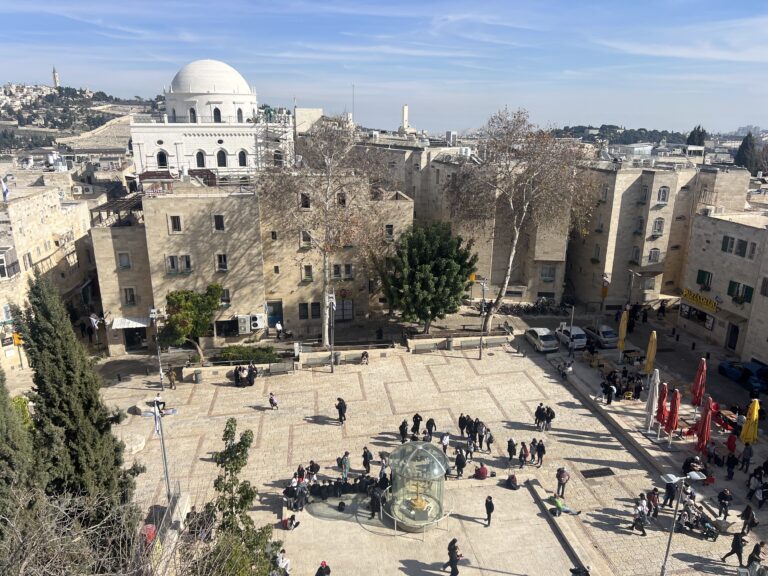
But of all the street names I have seen, one always stands out as my favorite. In the Old City of Yerushalayim, in the heart of the Jewish Quarter, there is a street named after a heretical sect of Jews that once posed a serious threat to our mesorah: Rechov HaKaraim, the Street of the Karaites. This street was once the center of Karaite life in the Old City. The Karaites denied the validity of Torah SheBa’al Peh, rejecting the Oral Tradition and relying exclusively on the Written Torah to derive Jewish practice. Throughout the Middle Ages, towering rabbinic figures such as the Rambam and Ibn Ezra battled the Karaites and their corrosive influence. Over time, the Karaite community dwindled, and the danger it posed to traditional Judaism faded.
Why am I so excited about a street in our holiest city named after a group of heretics?
In a penetrating essay on this week’s parshah, the Beit HaLevi (Shemot 12:42) explains that the true underlying cause of the Yerushalayim’s destruction was not merely political decay or disunity, but the denial of Torah She Ba’al Peh itself. During the Second Temple period, various heretical sects arose across Eretz Yisrael that rejected the oral traditions of Chazal. Among the most prominent and powerful were the Sadducees – unsurprisingly, the ideological forerunners of the Karaite movement many centuries later.
Once Jews splintered over the authority of Torah SheBa’al Peh, unity around the Torah became impossible. The shared language of halachah and mesorah eroded, giving way to suspicion, fragmentation, and ultimately baseless hatred. That internal disintegration, explains the Beit HaLevi, tore apart the social fabric of the nation and led directly to the destruction of the Beit HaMikdash.
For this reason, Chazal place such extraordinary emphasis on the study of Mishnah and the Oral Torah as a cornerstone of redemption. By reattaching ourselves to Torah SheBa’al Peh, we rectify the original breach that caused our disunity. In doing so, we prepare ourselves for reunion within the sacred four cubits of halachah, the havayot of Abaye and Rava.
The Karaite movement, and the threat it posed to our Mesorah, represented the lingering spiritual fallout of Yerushalayim’s destruction. A thriving Karaite presence in the Old City was a painful reflection of unfinished spiritual work. But as this once-vibrant sect gradually disappeared, and the fire of Torah SheBa’al Peh continued to burn brightly in the batei midrash of Klal Yisrael, a stark truth emerged: those who deny the
Oral Torah may challenge it for a time, but they do not endure. No matter how formidable they appear, they eventually fade. Torah and its faithful guardians will always emerge victorious.
The street sign commemorating the Karaites that once filled the streets of the Old City, while they themselves have vanished, stands as a quiet but powerful testimony. It reminds us that Torah SheBa’al Peh will always endure, while those who deny it are reduced to nothing more than a name on a sign.