No products in the cart.
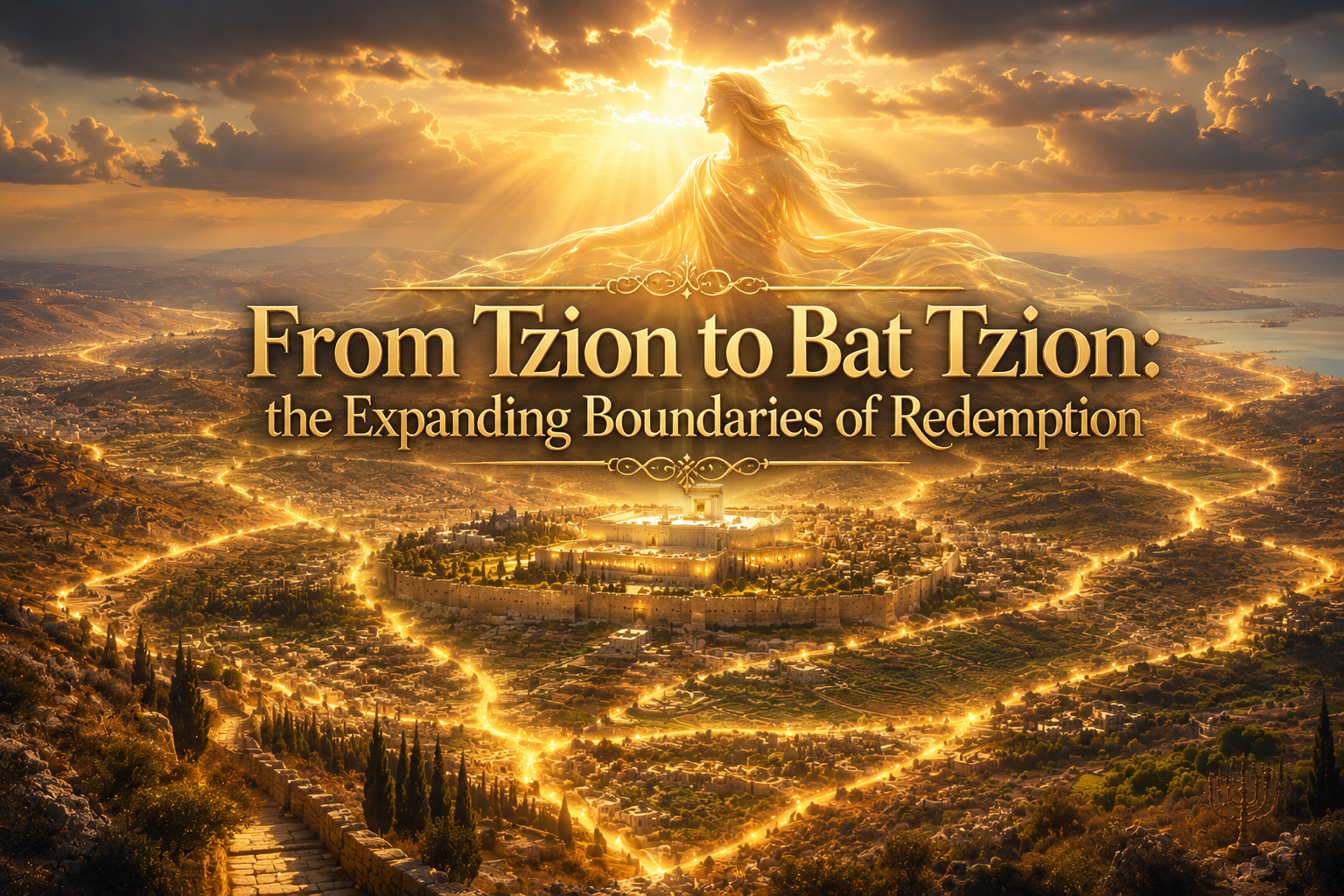
From Tzion to Bat Tzion: the Expanding Boundaries of Redemption
-
by
Rabbi Reuven Schrier
- No Comments on From Tzion to Bat Tzion: the Expanding Boundaries of Redemption
This week’s haftorah opens with the navi Zechariah (2:14) calling out to the Bat Tzion – daughter of Tzion – declaring that she should “sing and be glad.” The navi promises that Hashem will again dwell amongst this daughter of Tzion and choose Yerushalayim as His portion.
As we have noted in the past, Tanach and Chazal use Tzion and Yerushalayim interchangeably – both titles refer to our holy city. Therefore, the commentators note that Bat Tzion clearly refers to Am Yisrael – those who dwell within the city of Tzion.
This nevuah seems beautiful. But upon analyzing Zechariah’s prophecy in context, something strange emerges. Earlier, the navi dreams of an encounter with a man attempting to measure Yerushalayim. Two angles then arrive and inform Zechariah that such an exercise is futile: the city is destined to expand far beyond its walls due to an enormous influx of people, making current measurements pointless. The navi goes on to address Tzion – conspicuously not referring to Bat Tzion – and promises that He will dwell in her. He promises to be a protective wall of fire, punishing all those who once attempted to destroy her and occupy her.
Only after the vision of the angles and measuring line does Zechariah finally turn to the Bat Tzion and promise that Hashem will dwell in her. Why the separate references to Tzion and Bat Tzion? And why two separate promises regarding Hashem’s love and restoration?
The Alshich notes that the initial promise of redemption recorded by Zechariah in the beginning of chapter 2 is not due to the merits or worthiness of Am Yisrael. Hashem will not initially redeem Yerushalayim because of us. Rather, He will zealously pursue the honor of the holy city itself, for its own sake.
This is why Zechariah only emphasizes Hashem’s glory in the midst of the city, not the people. He will be a wall of fire protecting the city. Miraculously, Yerushalayim’s boundaries will exponentially expand beyond her walls, making her recently measured size irrelevant.
But eventually, the daughter herself will merit Hashem’s redemption. (Crucially, the Alshich notes that this will only be true once the children of Am Yisrael unify into a single organic unit in achdus, becoming a singular Bat Tzion.) Only then will Am Yisrael rejoice in the streets of Yerushalayim, recognizing that Hashem has now chosen to reside amongst them, not just His holy city.
The physical redemption of Yerushalayim and its miraculous expansion is only the beginning. When true unity is achieved – marked by a shared destiny and vision of eternity – the Bat Tzion will eternally rejoice within the ever expanding boundaries of her mother city.
monperatoto
monperatoto
situs toto
monperatoto
monperatoto
toto
monperatoto
monperatoto
monperatoto
monperatoto
monperatoto
monperatoto
monperatoto
monperatoto
monperatoto
monperatoto
monperatoto
monperatoto
monperatoto
monperatoto
monperatoto
situs gacor
link gacor