No products in the cart.
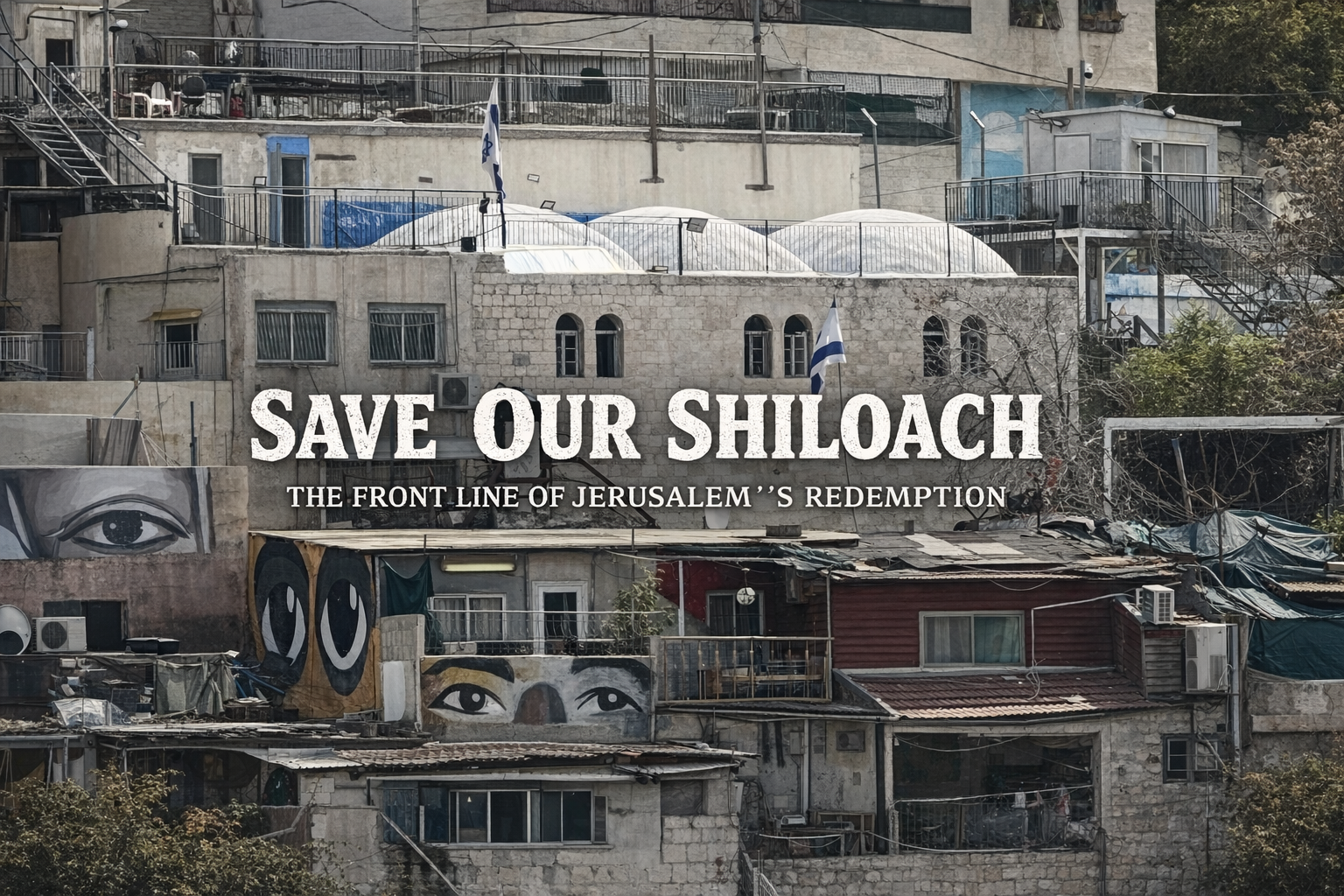
Save Our Shiloach: The Front Line of Jerusalem’s Redemption
 Daniel Luria
In the ongoing struggle over Jerusalem, one neighborhood stands at the symbolic and strategic center: Shiloach—known to the world as Silwan.
While much of eastern Jerusalem today is firmly in Jewish hands—with over 200,000 Jews living in neighborhoods like Ramot, Ramat Shlomo, Gilo, and Neve Yaakov—the battle is far from over. In the Old City and its immediate surroundings, the contest for control, identity, and presence is still active. And nowhere is that more evident than in Shiloach.
This is not just another neighborhood. It is ground zero.
For years, a coordinated effort—driven by elements within the Muslim world and supported by ideological activists—has sought to block the reestablishment of Jewish life in this historic area. Against that backdrop, the work of Ateret Cohanim has steadily, and quietly, shifted the reality on the ground.
The modern return began in 2004, with a single family entering Beit HaDvash, followed by additional families in Beit Yonatan. Since then, despite sustained violence—including thousands of firebomb and stone attacks—Jewish presence has expanded to nearly 50 families across more than ten buildings.
The real turning point came with the rediscovery and legal reclamation of the historic Yemenite synagogue complex. After Israel’s Supreme Court ruled that Arab residents in these properties were illegal squatters, the site was returned to its rightful trust. That decision opened the door to a broader realization: hundreds of additional properties—once part of the historic Yemenite Jewish settlement—remain occupied under similar circumstances.
Over the past year alone, more than a dozen apartments have been reclaimed. In many cases, departing occupants have deliberately damaged or destroyed the properties, leaving behind structures that require extensive rehabilitation. Restoration costs now range between $75,000 and $180,000 per unit.
And yet, the momentum is unmistakable.
In a coordinated operation just before Passover, ten additional apartments were returned. More are expected imminently. For the first time, even some of the most entrenched hostile elements in the area are being displaced.
This is a pivot point.
The addition of 20 to 25 new Jewish families could fundamentally reshape Shiloach—consolidating a continuous and resilient presence in one of Jerusalem’s most contested zones. What happens here will not stay local. It will define the trajectory of Jerusalem itself.
Because this is not only about real estate.
It is about continuity.
It is about sovereignty.
It is about whether Jerusalem’s story is something remembered—or something actively written.
The opportunity now is direct and tangible: rebuild homes, restore communities, and anchor a presence that cannot be easily reversed. From full property acquisition to sponsoring renovations, every level of participation translates into concrete change on the ground.
As Jerusalem Day approaches, the message is simple: this is the moment to decide what role you play in the city’s future.
Shiloach is no longer a distant idea.
It is the front line.