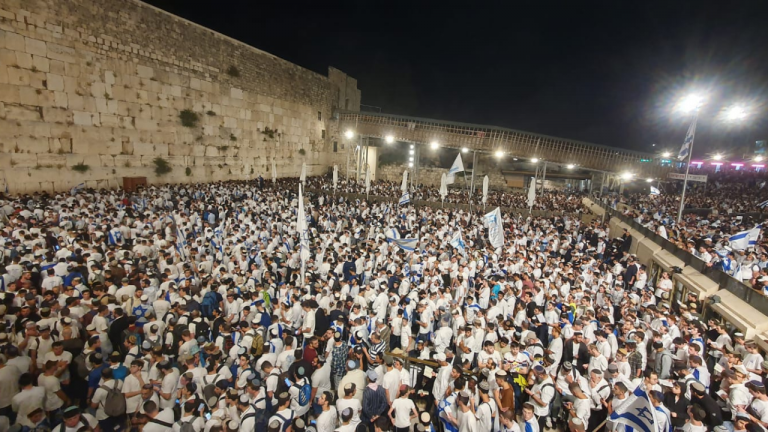
Returning the Lost Jews to Jerusalem

Our parsha mentions the mitzvah of hashavat aveidah (returning a lost object):  You shall not see your brother’s ox or sheep straying, and ignore them. [Rather,] you shall return them to your brother. But if your brother is not near you, or if you do not know him, you shall bring it into your house, […]

Explore more

Jerusalem and the Jewish Army

It is natural for soldiers to be scared when they go out to battle. An overly frightened army, though, can translate into a quick defeat. Therefore, before the Jewish soldiers leave to war, they are given a preparatory talk by a Kohen.  The Torah provides for us the text of the Kohen’s speech: Hear, O […]

Explore more

The Return to God’s Table

There are two ways for us to serve God: as slaves and as children. In multiple places the Torah declares that we are the slaves of God: “they are My slaves for I took them out of Egypt.” In our parsha, however, the Torah emphasizes that, in addition, we are also God’s children: “You are […]

Explore more

Feeling Awe In Jerusalem

In our parsha, Moshe highlights the importance of fearing God. In an important summary statement, Moshe delineates some of the general goals of the entire Torah: And now, O Israel, what does the Lord, your God, ask of you? Only to fear the Lord, your God, to walk in all His ways and to love […]

Explore more

The City of Loyalty

This week’s haftorah consists of Yeshayahu’s haunting prophecy regarding the corruption and future punishment of the Jewish people. While most of the perek relates to the Jewish people directly, at a certain point Yeshayahu transitions to addressing the city of Yerushalayim: How has she become a harlot, a faithful city (kiryah ne’emanah); full of justice, […]

Explore more

Swearing By Jerusalem

Our parsha opens with a discussion of oaths and vows. To be a bonified vow, the person taking the vow must mention God’s name or that of a sanctified item. This leads to several interesting Talmudic discussions regarding which formulations create a halachik vow and which do not. In this vein, Rabbi Moshe Feinstein was […]

Explore more

The Integrated Memory of Jerusalem

Bringing the sacrifices in the Mishkan and the Beit HaMikdash is referred to as an “avodah” or service of God. The fact that this specific form of service merits such a general name indicates that the lessons learnt from the world of sacrifices are applicable to our service of God more generally. With that in […]

Explore more

The Attack on the Torah of Jerusalem

In this week’s parsha we read about the attack of the King of Arad against the Jews when they are nearing the Land of Israel. While at first the Jewish people are taken by surprise, they soon pray to God and are saved. Rashi notes that in truth the attack came from the nation of […]

Explore more

The Leadership of Jerusalem

Korach did not believe in the divinely ordained structure of Jewish leadership. In a cynical and populist fashion he claimed: “the entire congregation are all holy, and the Lord is in their midst. So why do you raise yourselves above the Lord’s assembly?” Clearly, though, the same God who made the Jewish people holy also […]

Explore more

The Heroic Builders of Jerusalem

The Mishna in Pirkei Avot teaches us about the definition of strength and heroism: Who is strong? One who overpowers his inclinations. As is stated, “Better one who is slow to anger than one with might, one who rules his spirit than the captor of a city.” The one who is self-disciplined enough to control […]

Explore more