Ten Tragedies, One Slow Collapse
 Rabbi Reuven Schrier
Ten Tragedies, One Slow Collapse
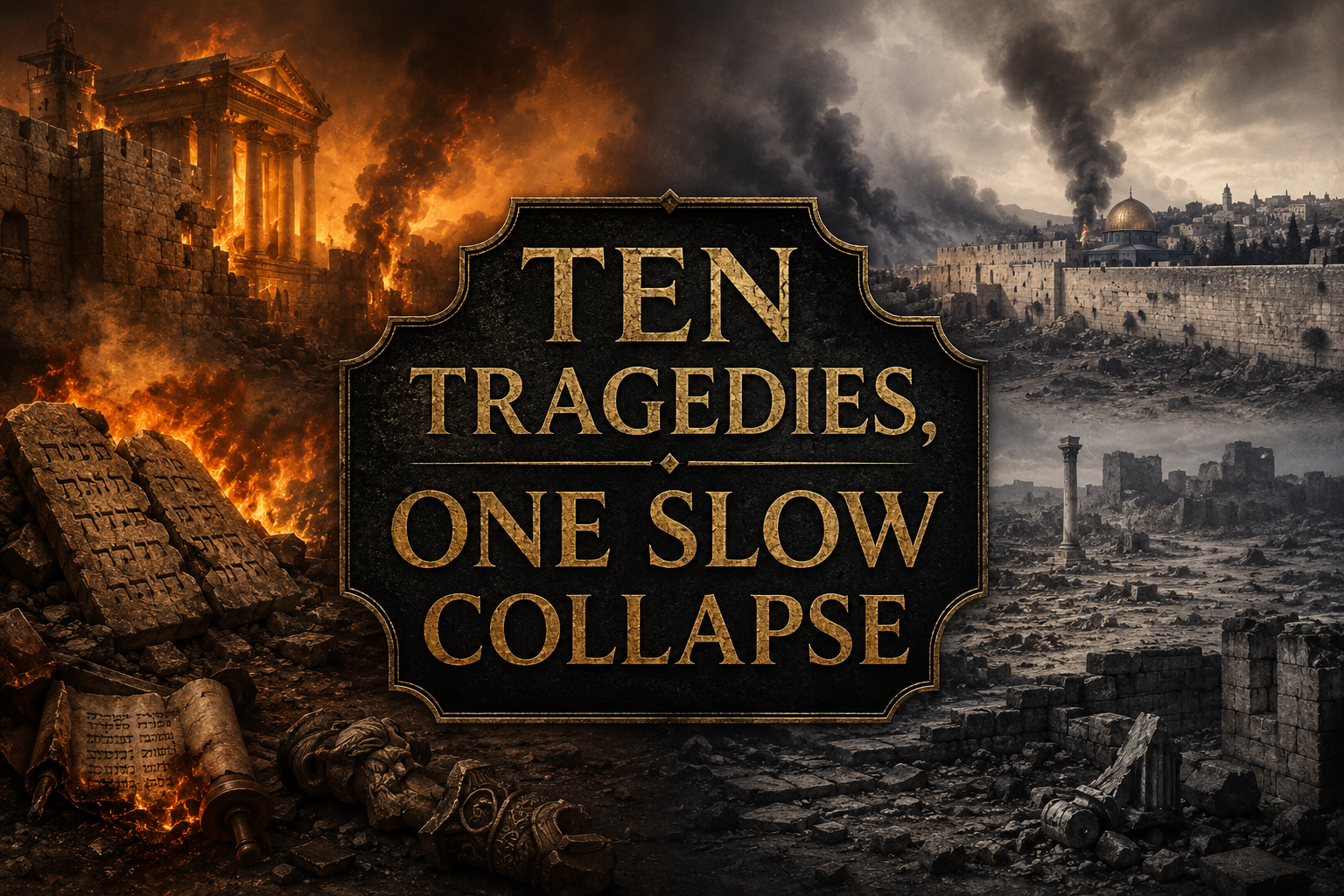
In the Mishna in Ta’anit, Chazal delineate five things that we mourn during the fast of Shiva Asar beTammuz: 1) the luchot were broken, 2) the korban tamid was discontinued (the Rishonim debate whether this occurred during the First or Second Beit HaMikdash), 3) the walls of Yerushalayim were breached by the Romans, 4) the Greek general Apostomus burned the Sefer Torah found in the heichal, and 5) an idol was erected in the Mikdash (presumably by Menashe, king of the Judean kingdom during the first temple).
The Mishna also notes that we mourn five things on Tisha Be’Av as well: 1) it was decreed that our ancestors in the midbar would not enter Eretz Yisrael, 2/3) the two Batei Mikdash were destroyed, 4) Beitar – the last bastion of Jewish resistance to the Romans – was crushed, and 5) the city of Yerushalayim was plowed over.
The Maharal (Netzach Yisrael 8) reveals that the numerical lists of Chazal are never happenstance or haphazard. In total, the events we mourn over the course of these next Three Weeks total ten. These ten tragedies parallel other significant expressions of the number ten, such as the Presence of the Shechinah when a minyan convenes. There were ten consistent miracles in the Mikdash and Yerushalayim, reflecting an all-encompassing love and powerful relationship between Hashem and His people (Avot 5:5). The ten destructions that we mourn represent a reversal of this sanctity, a “withdrawal” of this intimate relationship.
The Maharal sharply notes that these two sets of five also reflect bookends of destruction. The tragedies of Sheva Asar beTammuz are only the beginning of the destructive process; theoretically, the ultimate catastrophe could still be averted. The luchot would be replaced. Moshe’s advocacy succeeded in averting disaster, and within 40 days a second set of luchot was carved. The korban tamid was discontinued, but could be restored in an instant. Walls can be repaired. A burned Sefer Torah can be written again. And an idol can be torn down.
But the disasters of Tisha Be’Av are “final”, sealed into our national destiny: even Moshe Rabbeinu could not annul the decree that the generation of Yotzei Mitzrayim would wander and die in the midbar. The destruction of the Batei Mikdash led to definitive exile. Beitar was the last flame of Jewish resistance, brutally extinguished. And the plowing over of Yerushalayim was specifically intended to create a sense of permanent hopelessness; the old Jewish capital had been plowed away, and the new Roman capital of Aelia Capitolina was planted in its stead.
Essentially, Tisha Be’Av is the final nail in the coffin first built on Sheva Asar beTammuz.
This point is not merely historical. It defines the emotional progression of the Three Weeks, the miserable process of the Bein HaMitzarim that we are experiencing once again. As the Rav zt’l noted, these Three
Weeks are the inverse of aveilut. Instead of mourning in response to the irreversible conclusion of life, the loss of Yerushalayim slowly unfolds. It begins with tragedies that forewarn the possibility of total collapse, yet still allow for hope that the destruction can be averted. But as Tisha Be’Av draws near, the final destruction becomes increasingly inevitable. We are forced to relive the slow destruction of Yerushalayim, metaphorically watching her diminish until the smoldering remains of our beloved city lie before us on Tisha Be’Av night.
This is why Chazal did not compress these tragedies into a single day of mourning. We first relive the breach, then the unraveling, and finally the destruction itself. Only by allowing ourselves to feel the slow dread of impending loss can we truly feel the gaping hole that Yerushalayim’s destruction left. And only by experiencing that desperate sense of loss can we take the first step toward seeing her rebuilt.