No products in the cart.
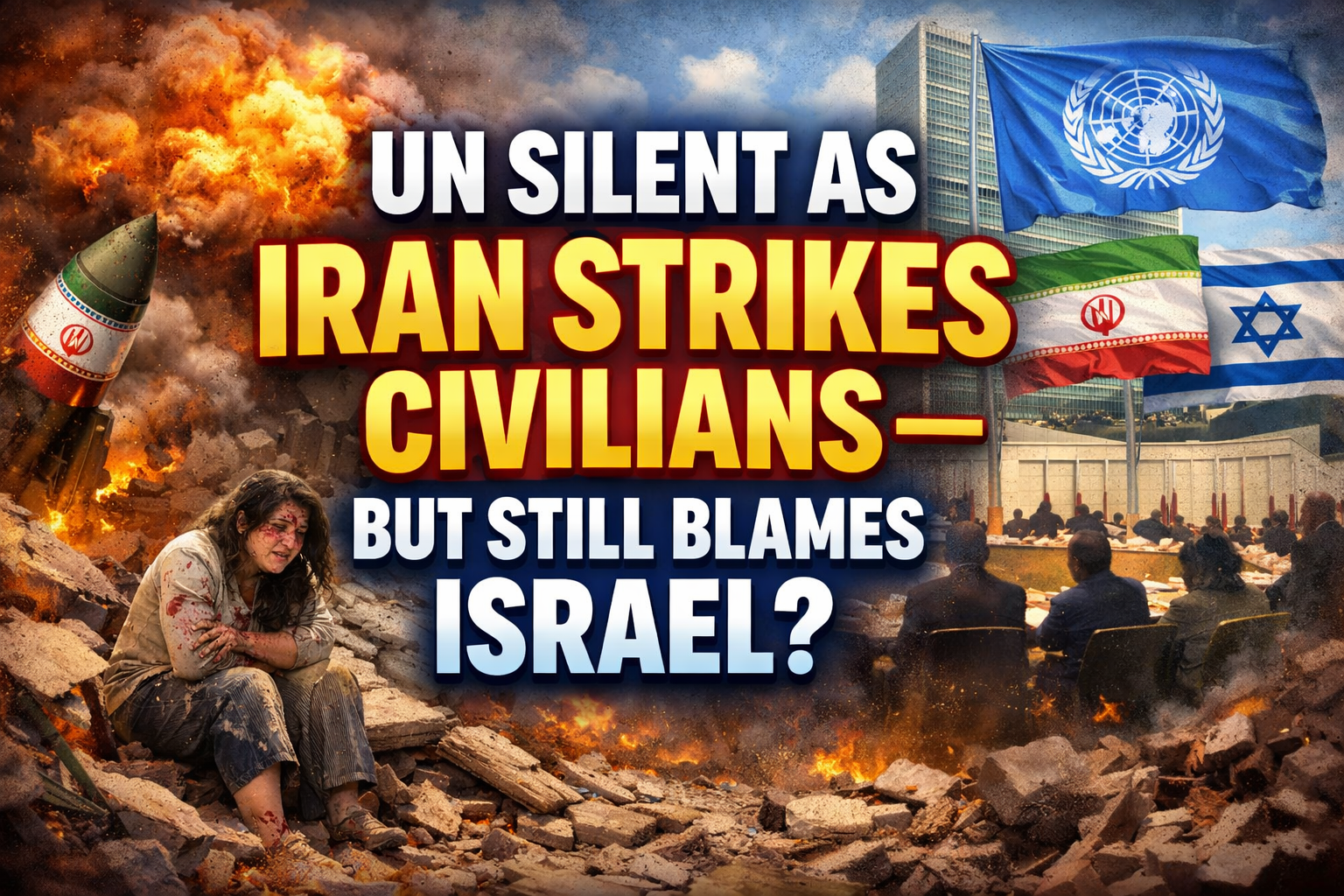
UN Silent as Iran Strikes Civilians — But Still Blames Israel?
 Daniel Luria
When over 1,100 Israeli civilians were massacred by Hamas—men, women, children, entire families—the international system reacted with hesitation, equivocation, and, in some cases, moral inversion. Yet when Israel responded, as any sovereign state must, the reflex was immediate: condemn, constrain, and scrutinize. The expectation is not balance—it is asymmetry. Israel is judged not against its enemies, but against an abstract moral ideal that no other nation is required to meet in the face of existential threat.
Now the contrast is even sharper.
A fundamentalist Iran openly fires ballistic missiles and deploys indiscriminate weapons toward civilian population centers. This is not ambiguous warfare. It is not a gray-zone operation. It is direct, state-backed aggression targeting civilians. And yet, the same institutions that find their voice so quickly when Israel acts are conspicuously muted.
This is not oversight. It is a hierarchy of outrage.
Across the region—and far beyond it—the evidence is overwhelming. Mass killings in the name of extremist ideology. Entire populations displaced. Religious minorities erased. Millions turned into refugees. These are not isolated घटनाएँ; they are part of a broader pattern driven by radical forces that destabilize entire regions.
And still, the international response is inconsistent at best, willfully blind at worst.
But when Israel stands—when it absorbs the blow and then acts decisively to defend its people—it becomes the focal point of condemnation. Not because it is uniquely guilty, but because it is uniquely visible, uniquely accountable, and, in many cases, uniquely expected to restrain itself even as its adversaries do not.
That is the strategic reality.
Israel does not have the luxury of illusion. It cannot subcontract its security to international bodies whose record shows selective enforcement and politicized judgment. It must rely on its own capabilities, its own clarity, and its own resolve.
History suggests that institutions rise and fall. Credibility, once lost, is rarely regained. The current trajectory of international bodies that have abandoned consistency for politics is not sustainable over the long term.
Israel, however, operates on a different timeline.
It is a state built not only on power, but on continuity—historical, cultural, and strategic. It has faced existential threats before and will face them again. The difference is that Israel has learned the central lesson of its history: survival is not granted; it is secured.
And so while others debate, delay, or deflect, Israel will continue to do what it has always done—stand, defend, and endure.
Because in the end, legitimacy is not determined by resolutions. It is determined by reality.