Yichud and Pirud: The Spiritual Geography of Yaakov’s Ladder
 Rabbi Reuven Schrier
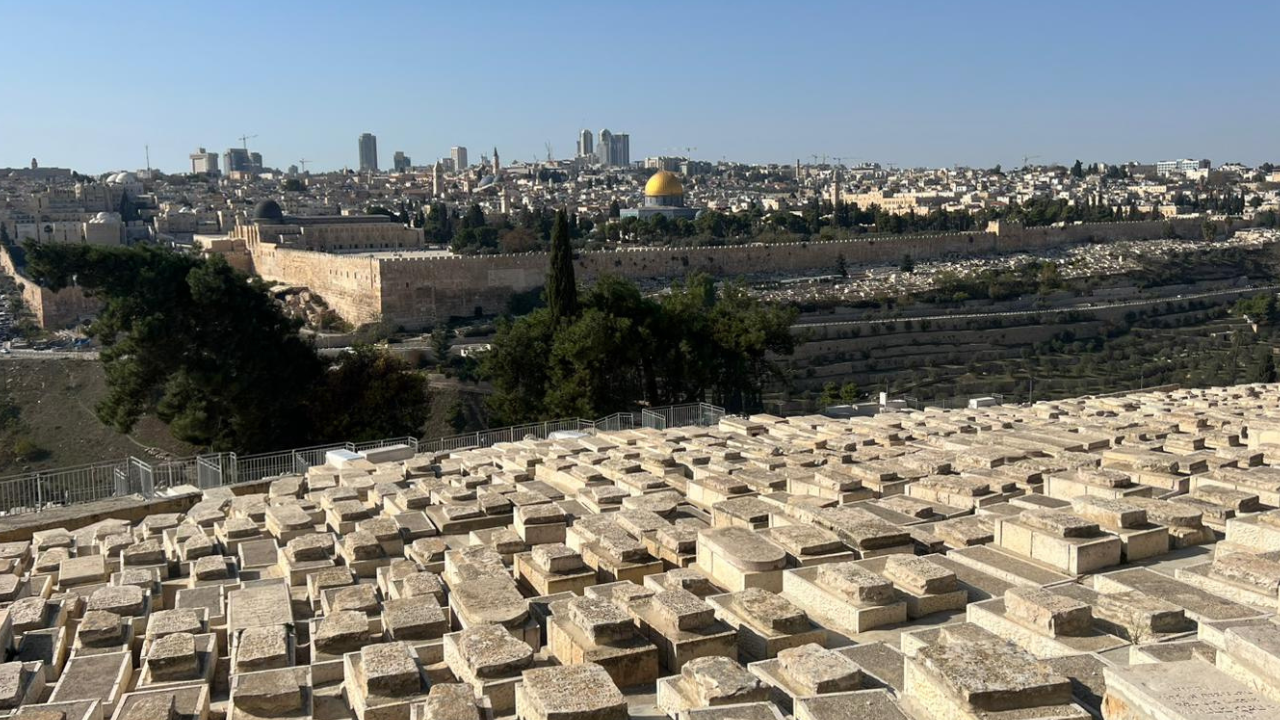
In Yaakov Avinu’s famous dream, he sees a supernal ladder that binds earth and heaven. At first glance, the ladder’s location would seem to be Yerushalayim. After all, when Yaakov awakens he exclaims that this is the “house of God and gateway of heaven!”
Yet the ladder’s true location is far from straightforward. While its association with Yerushalayim seems clear, Yaakov also names the site of his dream Beit El, and the Torah explicitly tells us that this became the name of the city formally named Luz. As Rashi notes (Rashi, Bereishis 28:17), Beit El lies on the northern border of Binyamin and Ephraim, whereas Yerushalayim sits on Binyamin’s southern border, adjacent to Yehuda.
Rashi resolves the contradictions by explaining that this vast spiritual ladder spans multiple locations. Its base was rooted in Be’er Sheva, while its top “penetrated” to the heavens over the city of Luz. Its midpoint, suspended between heaven and earth, passed over Yerushalayim.
In this seemingly technical geographic discussion of the ladder’s placement, Rabbeinu Bachya (Bereishis 28:13) sees deep kabbalistic significance (I am adding slightly to his analysis). When HaKadosh Baruch Hu “introduces” Himself to Yaakov, He does so as the “God of Avraham your father, and the God of Yitzchak.” Avraham and Yitzchak famously represent the Divine attributes of gedulah and gevurah, expansive kindness and exacting strength.
Normally, these attributes stand in tension: Divine compassion on one hand, and Divine judgment on the other. They seem impossible to merge and coexist, But Yerushalayim’s unique spiritual capacity to reconcile opposites and unite conflicting forces allows for the seamless combination of Avraham’s and Yitzchak’s paradigms. It is no coincidence that the Akeidah, where both Avraham and Yitzchak simultaneously achieved their exalted spiritual missions, occurred at the very site of the Beit HaMikdash.
The ladder’s suspension over Yerushalayim thus symbolizes the holy city’s ability to harmonize the extremes of this ladder. Beit El and Be’er Sheva correspond to the distinct spiritual paradigms of Avraham and Yitzchak. Upon first arriving in Eretz Yisrael, Avraham erected a mizbeach near the city of Beit El and called out in the name of Hashem (Bereishis 12:8). The Torah uses the exact same formulation to describe Yitzchak’s mizbeach in the city of Be’er Sheva (Bereishis 26:23). Yaakov, the perfect synthesis of his illustrious forebearers, lies beneath the ladder’s midpoint in Yerushalayim, uniting these unique spiritual legacies.
Centuries later, Yerushalayim’s power to unify is revealed through its tragic opposite: pirud – spiritual fragmentation. When Yerovam ben Nevat rebels and establishes an independent kingdom in Ephraim, he fears that the people will still travel to Yerushalayim. To prevent this, he sets up two golden calf-idols, one in Beit El and the other in Dan (Melachim Alef 12:29). Rabbeinu Bachya explains that Yerovam intentionally created two different centers of worship to reflect the now divided spiritual paradigms of Avraham and Yitzchak. Whereas Yerushalayim engenders yichud and oneness, abandoning the holy city breeds, pirud, multiplicity, and disintegration. Divorced from Yerushalayim, the northern kingdom was doomed to drown in wanton idol worship, the very sin that replaces Hashem’s unity with a multiplicity of gods. Yerushalayim is the ultimate unifying force in the cosmos. May we speedily witness her reclaiming her mantle as the center of Yaakov’s supernal ladder.