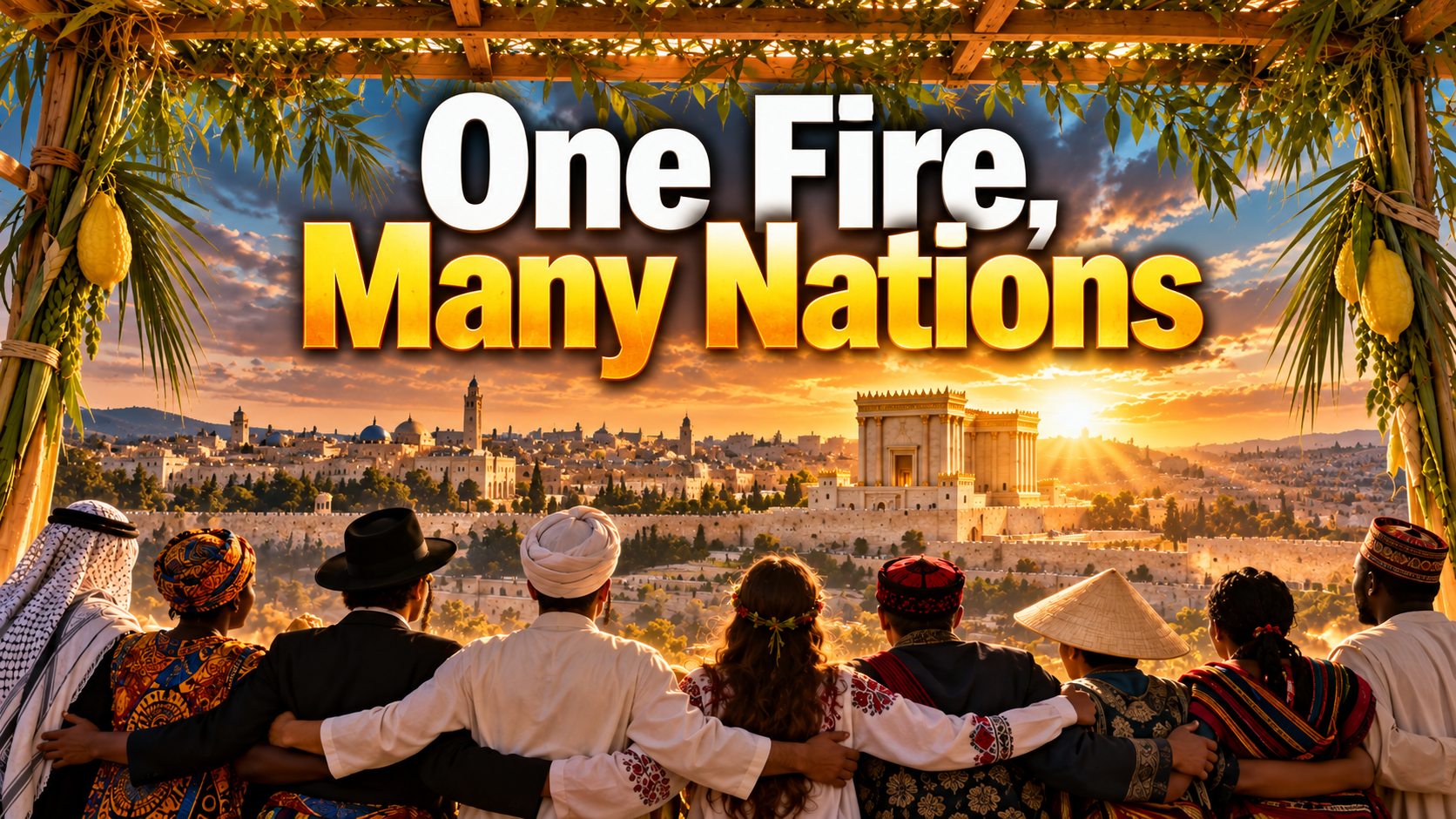
One Fire, Many Nations
 Rabbi Reuven Schrier
Last week, we discussed Hashem’s insistence that the Mikdash be built in the ancestral portion of Binyamin, and that its construction could only be completed by Shlomo HaMelech. Both of these biblical figures are granted the unique title Yedid – beloved of Hashem – because of their ability to foster peace and brotherhood.
But why is peace so intimately bound to Yerushalayim and the Mikdash?
A hint to the answer can be found in our liturgy, where we refer to Yerushalayim as Sukkat Shelomecha, “Your Canopy of Peace.” Somehow, the city is comparable to a sukkah. And seemingly, it is this sukkah-like quality that enables Yerushalayim to become a place of peace.
This relates to a broader theme of Sukkot, indeed of all the holidays of Tishrei: the unification of humanity under the banner of Hashem’s malchut in this world. The Yomim Noraim Amidah is filled with references to the revelation of Hashem’s kingship, causing all the nations to unite k’agudah achat – as one bundle – to fulfill His will.
Over the course of Sukkot, we are commanded to bring 70 mussaf bulls, corresponding to the 70 nations of the world. These korbanot reflect the culmination of this vision. The korban represents absolute dedication to Hashem. The nations represented by these korbanot possess vastly different cultures, philosophies, and strengths. Yet all seventy offerings ultimately meet the same fate: they are placed upon the same altar and consumed by the same fire, rising together in the service of the Almighty.
True peace can only be achieved when the varying skills, perspectives, and personalities of different human beings and societies can be appreciated as different pieces of a larger puzzle, each contributing to a unified picture. Yerushalayim is the city where those disparate pieces can be brought together into a single, unified whole.
As the seat of Hashem’s kingship, beneath the canopy of His Divine Presence, Yerushalayim allows humanity to see beyond its individual interests and recognize how each person, tribe, and nation has a unique role to play in fulfilling Hashem’s will. Peace does not require the elimination of difference, but rather the appreciation of difference in the pursuit of the overarching goal of Hashem’s kingship.
Binyamin represents this quality within Klal Yisrael. He is the shevet in whose portion the tribes can come together without their differences becoming a source of division. The varying tribes are not competing alternatives, but distinct and essential components of Hashem’s Divine plan. Only a shevet that can embrace the distinct roles of the other shevatim while uniting them around a common purpose can merit hosting the Shechinah at Yerushalayim’s spiritual center.
What Binyamin was for the tribes of Yisrael, Shlomo HaMelech was meant to be for the nations of the world.
Because of his extraordinary wisdom and towering spiritual stature, Shlomo was uniquely capable of seeing the larger picture of Creation and discerning the distinctive role of each nation within it. The nations that came before him could see their own power and interests; Shlomo could show them how those individual strengths could become part of something greater.
And this explains why Shlomo naturally dedicated the Mikdash as a house of prayer for all nations. Yerushalayim would become a place where all nations would converge in order to seek spiritual guidance and connection with Hashem’s divine plan.
That is the deeper meaning of Sukkat Shelomecha. A sukkah – with its humble simplicity – allows us to transcend the pettiness of everyday life and focus on the enveloping Presence of HaKadosh Baruch Hu. The sukkah reveals the truth of human frailty, our desperate dependence on Hashem’s divine protection. When the true King is the source of everything, it is silly to squabble and struggle.
This is why the ultimate vision of Yerushalayim is not simply a city where there is no conflict, but a city where the entire world finally recognizes how all of its varying pieces perfectly fit together.