No products in the cart.
The Joy of Surrender
 Rabbi Reuven Schrier
The Joy of Surrender
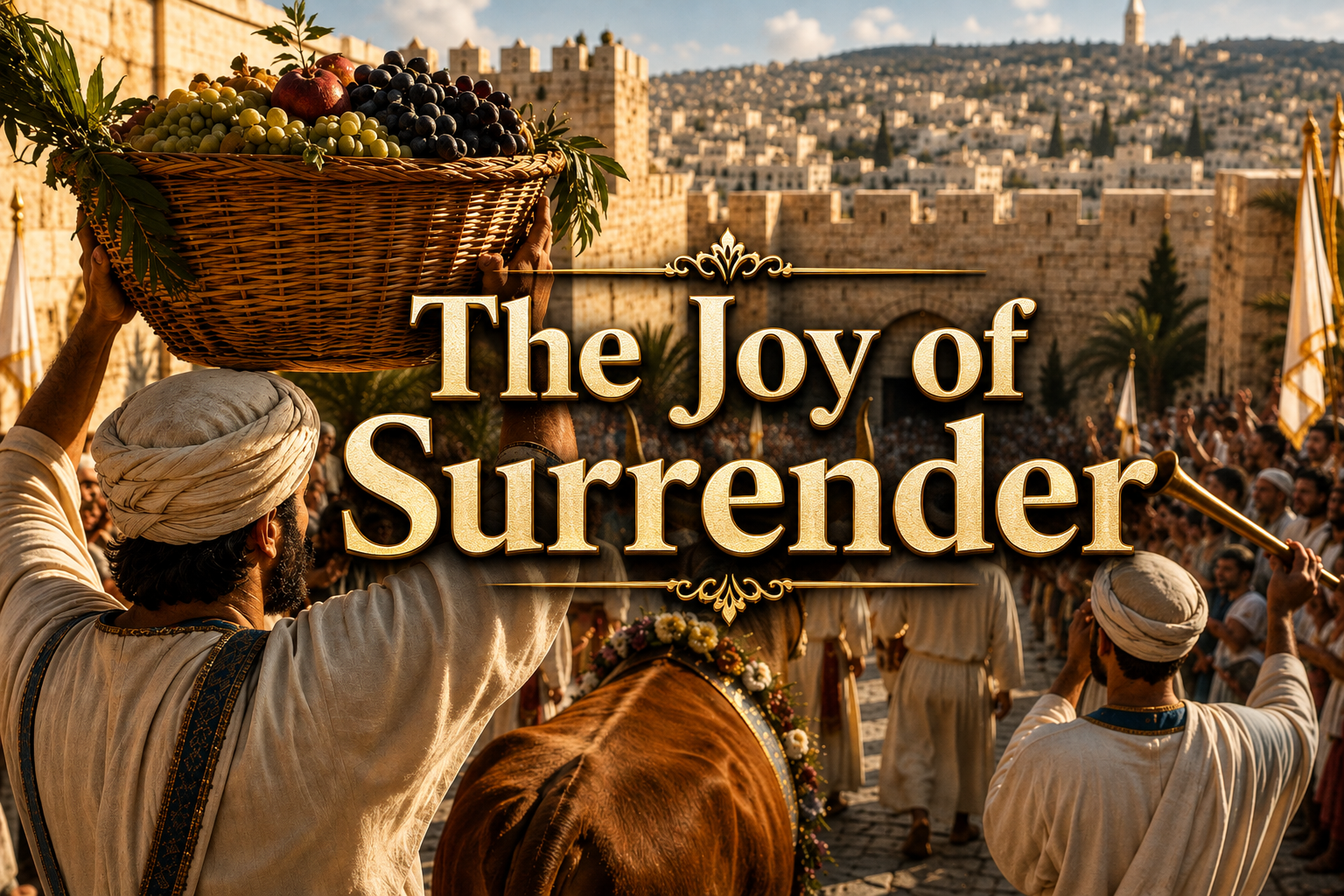
The Mishna in Masechet Bikkurim describes the elaborate and joyous process of bringing the First Fruits to Yerushalayim (particularly in chapter 3). The farmers would deliberately gather in local cities before embarking on their journey to the Beit HaMikdash, creating great processions of Bikkurim-bearers and glorifying Hashem’s name as throngs of people converged upon Yerushalayim to perform this mitzvah.
An ox, its horns gilded in gold, would ceremoniously lead the procession of Bikkurim-bearers. It would eventually be brought as a shelamim sacrifice, specially accompanying the Bikkurim upon arrival in the courtyard of the Beit HaMikdash (see Bartenura to Bikkurim 3:3). The special chalil – the ceremonious flute that was played on particularly joyous occasions in the Mikdash – also accompanied the procession.
When the farmers reached the edge of Yerushalayim, distinguished officials and leaders would come out to greet them. As the Bikkurim-bearers walked through the streets of Yerushalayim, everyone stood in their honor, even those engaged in work or occupied in Torah study (Bikkurim 3:3 with Mishna Rishona).
All of these highly unique celebratory practices created an extremely festive environment in Yerushalayim as the Bikkurim season was underway. But they raise a basic question. As the Mishna Rishona points out, there is another agricultural mitzvah that necessitates bringing sanctified produce to Yerushalayim. The mitzvah of Ma’aser Sheni also involves setting aside a significant amount of produce that can only be consumed within the walls of Yerushalayim. Farmers likewise converged upon Yerushalayim to fulfill this mitzvah.
So where were the Ma’aser Sheni oxen? Where were the flutes and the processions? Why did those bringing Bikkurim merit such extraordinary honor and celebration, while those fulfilling the mitzvah of Ma’aser Sheni did not?
Tucked away in the Mishna Bikkurim is a curious formulation that may provide the key to understanding this fundamental difference. The Mishna (3:2) records that the Bikkurim-bearers would first gather in their local cities and sleep over in the streets of the city before departing for Yerushalayim. The next morning, they would rise and begin their journey. In describing this awakening, the Mishna uses a striking word: ולמשכים.
At first glance, the word simply means that they arose early in the morning. But a careful reader cannot miss its resonance with one of the Torah’s most fundamental journeys to this very place.
When Avraham Avinu was commanded to travel to Har HaMoriyah and offer Yitzchak as a sacrifice (Bereishis 22), he too arose early in the morning to begin his journey towards the future makom HaMikdash. The verse describes his rise with a familiar phrase: וישכם אברהם בבקר – and Avraham arose early in the morning.
The Mishna’s deliberate usage of this term in reference to Bikkurim is not simply to emphasize alacrity: it points toward the very essence of Bikkurim.
When Avraham Avinu was commanded to sacrifice his precious son, he was being called upon to return everything he had achieved in this world back to his Creator. Before the Akeidah, Avraham had come to realize that his entire legacy of monotheism, morality, and kindness would be perpetuated through Yitzchak Avinu alone; and yet, he was now being called upon to surrender this back to the Ribbono Shel Olam.
His alacritous rise to perform this command reflects his total and absolute bittul – self-nullification and surrender before Hashem. This allows us to understand why this awesome sacrifice was specifically intended to occur on Har HaMoriyah. The Har HaBayis was the very place from which Creation first emerged. It was the place where we were first granted “independent” existence that allows us to imagine that what we possess is truly ours. And it was there that Avraham was called upon to return everything.
The journey of the Bikkurim-bearer is a microcosm of Avraham’s journey.
In contrast to Ma’aser Sheni, which closes the process of agricultural mitzvot, the mitzvah of Bikkurim reflects an essential initial act of surrender that defines and contextualizes everything that follows. By taking the first fruits to the Mikdash – the gate to the heavens and cradle of the universe – and reciting the verses of ארמי עובד אבי that harken back to our forefather Avraham (see Ibn Ezra to 26:5), a farmer is symbolically surrendering his toil and tears to the Ribbono Shel Olam. In order for this to reflect a true sense of bittul, in which the totality of Jewish history and destiny wholly submits itself before the King of Kings, the mitzvah must be glorified with a unique sense of simcha and honor.
The farmer came to Yerushalayim carrying his first fruits—but, like Avraham rising early toward Har HaMoriyah, he was really bringing something far greater; his very essence and the totality of existence.
toto togel
toto togel
situs gacor
situs togel
toto togel
toto togel
toto togel
link gacor
toto togel
link gacor
togel online
slot gacor
link gacor
situs gacor
toto togel
kampungbet
toto togel
link gacor
toto togel
situs togel
situs togel
toto togel
link gacor
slot gacor
slot gacor
situs togel
togel online
kampungbet
situs gacor
toto togel
slot gacor
link gacor
situs hk
situs hk
situs toto
slot gacor
link gacor
situs toto
situs togel
toto
link gacor
slot gacor
link gacor
situs gacor
toto togel
situs toto
toto togel
toto togel
toto togel
toto togel
toto togel
kampungbet
kampungbet
kampungbet
situs gacor
situs gacor
toto togel
kampungbet
kampungbet
situs gacor
kampungbet
kampungbet
kampungbet
kampungbet
kampungbet
kampungbet
kampungbet
kampungbet
kampungbet
kampungbet
kampungbet
kampungbet
kampungbet
kampungbet