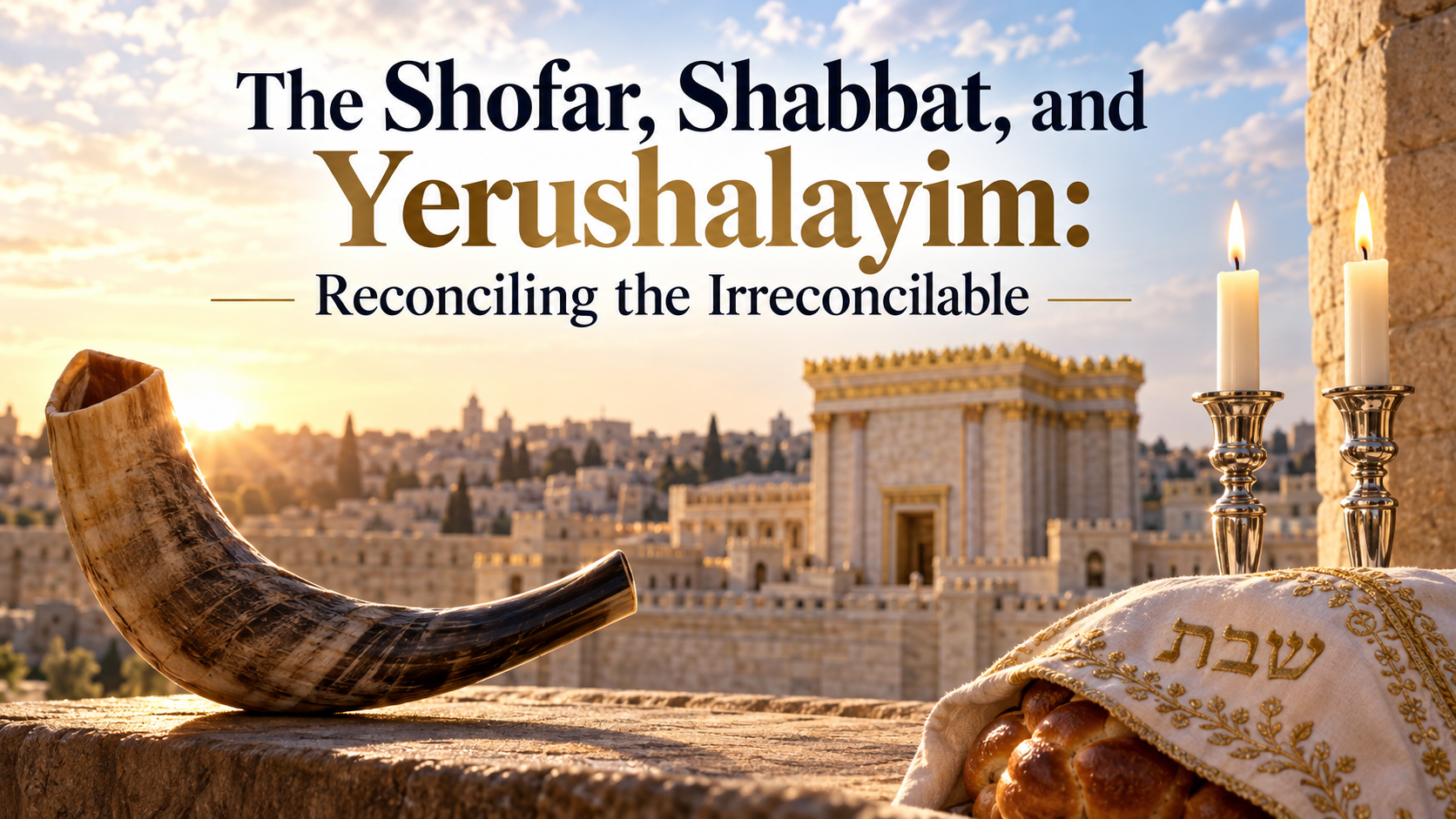
The Shofar, Shabbat, and Yerushalayim: Reconciling the Irreconcilable
-
by
Rabbi Reuven Schrier
- No Comments on The Shofar, Shabbat, and Yerushalayim: Reconciling the Irreconcilable
On the first day of Rosh HaShanah this year, our shuls will remain silent from the call of the shofar. But in an ideal world, the shofar blasts would still sound – even on Shabbat – in the Beit HaMikdash.
The Gemara Rosh HaShanah (29b) explains that the Rabbis prohibited the blowing of the shofar on Shabbat lest it lead to Shabbat desecration through carrying the shofar in the public domain. Technically, the Mikdash is excluded from this concern because the Rabbis did not apply their rabbinic prohibitions in the Mikdash (Rashi ad loc.).
This prohibition and its Mikdash exception seem purely technical. However, the Shem MiShmuel (Rosh HaShanah 5671) sees a far deeper meaning in our distinct treatment of the Mikdash and the world outside it.
Based on a brilliant and complex analysis of the Talmud Yerushalmi and Bavli, the Shem MiShmuel reveals that the shofar and Shabbat normally represent two seemingly contradictory spiritual states.
The shofar is an instrument of shiflut – a reflection of our lowly and desperate state. The Yerushalmi in Ta’anit (2:1) compares the shofar’s call to the primal cry of an animal. We are speechless, helpless, and utterly dependent upon Hashem much as an animal depends on the mercy of its master. When we turn to Hashem in desperation, begging that He redeem the holy neshamah entrapped within the oppressive shell of this world, He responds with an outpouring of Divine compassion that uplifts and delivers us from the straits.
But, as the Shem MiShmuel describes throughout his writings, Shabbat is not a time for such feelings of lowliness. On Shabbat, a Jew triumphantly revels in Hashem’s Presence, feeling the distinct delight of being chosen and participating in cosmic renewal. We sanctify every Shabbat in Kiddush with a description of Hashem’s desire and love for us.
The spirit of Shabbat and the outcry of the shofar therefore clash. Their spiritual messages seem to be irreconcilable and mutually exclusive.
But in the heart of Yerushalayim, the Mikdash reveals a new reality.
In Yerushalayim, a Jew is elevated to the point where these seemingly diametrically opposed messages can coexist and become part of a single spiritual experience. What from
a place of smallness appears irreconcilable can, in the Mikdash, be seen as two dimensions of the same relationship with Hashem.
The lowliness, animal-like desperation of the shofar can merge with the uplifting exaltedness of Shabbat. We can simultaneously recognize how utterly dependent we are upon Hashem and how deeply beloved we are by Him. We can cry out from our lowliness while standing in His Presence.
Perhaps this is one of the great secrets of Yerushalayim. It is the place where contradictions that cannot be reconciled anywhere else are brought together.