No products in the cart.
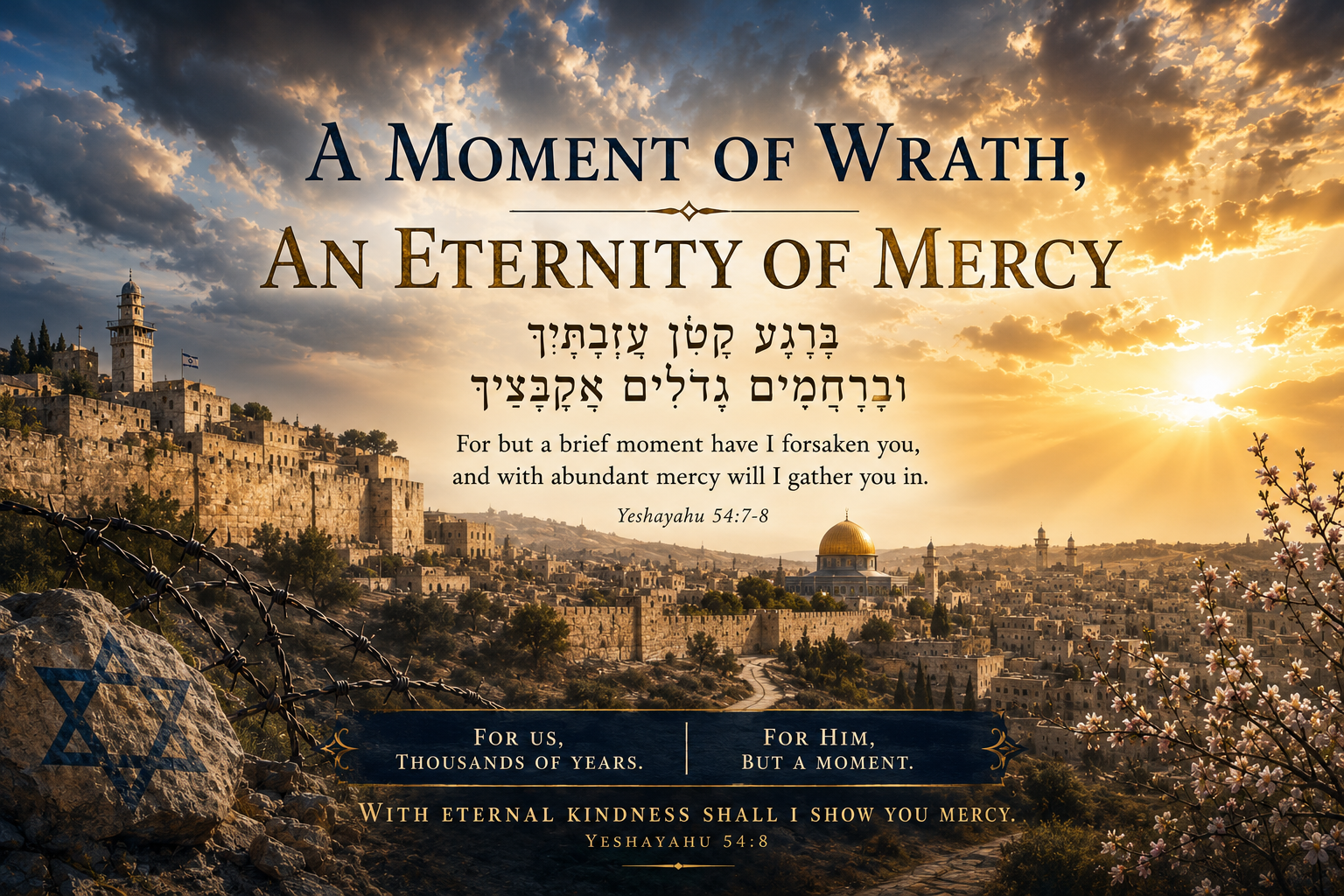
A Moment of Wrath, An Eternity of Mercy
 Rabbi Reuven Schrier
A Moment of Wrath, An Eternity of Mercy
In this week’s haftorah, Yeshayahu continues to console us with promises of redemption and Divine love (Yeshayahu 54). He again calls out in the name of Hashem to the barren Yerushalayim, telling her to rejoice and sing over her restoration. In the midst of these promises of redemption, God assures Yerushalayim that her days of suffering and disgrace will be short-lived. Tzion is compared to an estranged, disloyal wife who will be gathered back into her Beloved’s embrace:
בְּרֶ֥גַע קָטֹ֖ן עֲזַבְתִּ֑יךְ וּבְרַחֲמִ֥ים גְּדֹלִ֖ים אֲקַבְּצֵֽך – For but a brief moment have I forsaken you, and with abundant mercy will I gather you in.
בְּשֶׁ֣צֶף קֶ֗צֶף הִסְתַּ֨רְתִּי פָנַ֥י רֶ֙גַע֙ מִמֵּ֔ךְ וּבְחֶ֥סֶד עוֹלָ֖ם רִֽחַמְתִּ֑יךְ אָמַ֥ר גֹּאֲלֵ֖ךְ יְקֹוָֽק – With a slight wrath have I concealed My countenance from you for a moment, but with eternal kindness shall I show you mercy, said your Redeemer, Hashem.
Hashem finally swears with an eternal oath – similar to the oath He swore to Noach after the waters of the great flood receded – that Tzion will never suffer again.
These verses are lyrical and beautiful, brimming with hope and consolation. But an obvious question is also impossible to ignore. Reading this haftorah today – after millennia of brutal suffering and Divine concealment – one cannot help but wonder how Yeshayahu could possibly refer to our exile as a “רגע קטן – a brief moment”. How can the horrors of the Holocaust, along with the countless persecutions, expulsions, and tragedies that have permeated our history, be referred to as “שצף קצף – a slight wrath”?!
While a fully sufficient answer will not be understood until the completion of the final redemption, we can at least begin to grapple with this formidable question by referencing an essential verse tucked away in sefer Tehillim (90:4):
כִּ֤י אֶ֢לֶף שָׁנִ֡ים בְּֽעֵינֶ֗יךָ כְּי֣וֹם אֶ֭תְמוֹל כִּ֣י יַעֲבֹ֑ר – For a thousand years are in Your eyes like yesterday, which passed.
The Gemara Sanhedrin (97a) explains that this verse reveals a radical distinction between mortal man and his Divine Creator regarding time. Over the course of a thousand years, man perceives a slow progression of time, with dozens of generations being born into this world and gradually fading away into distant memory. And yet, for HaKadosh Baruch Hu, the Source of existence and Creator of time itself, a thousand years merge seamlessly into a single unified event – a Divine “day” that passes like the blink of an eye.
From a mortal perspective, the pain and suffering of thousands of years cannot be dismissed or ignored. It is simply too overwhelming and tragic, no matter the theological explanations of why such agony is justified.
However, as Klal Yisrael is welcomed back into the home of its Divine Husband, we will begin to see history through the lens of eternity. What once appeared to be a never-ending exile will be revealed as a backdrop of the eternal relationship between Hashem and His people.
United with HaKadosh Baruch Hu and deeply intertwined with His will, our perspective will begin to shift towards Hashem’s Divine calculations that are beyond time and physical limits. The exile that seemed endless will finally be seen for what it was: a “רגע קטן” – a brief moment – within the vastness of Hashem’s eternal plan.
For us, it will be thousands of years. For Him, it will be but a moment. And at the end of that moment will come the eternal embrace that Yeshayahu promised us long ago: “With eternal kindness shall I show you mercy.”
toto togel
toto togel
situs gacor
situs togel
toto togel
toto togel
toto togel
link gacor
toto togel
link gacor
togel online
slot gacor
link gacor
situs gacor
toto togel
kampungbet
toto togel
link gacor
toto togel
situs togel
situs togel
toto togel
link gacor
slot gacor
slot gacor
situs togel
togel online
kampungbet
situs gacor
toto togel
slot gacor
link gacor
situs hk
situs hk
situs toto
slot gacor
link gacor
situs toto
situs togel
toto
link gacor
slot gacor
link gacor
situs gacor
toto togel
situs toto
toto togel
toto togel
toto togel
toto togel
toto togel
kampungbet
kampungbet
kampungbet
situs gacor
situs gacor
toto togel
kampungbet
kampungbet
situs gacor
kampungbet
kampungbet
kampungbet
kampungbet
kampungbet
kampungbet
kampungbet
kampungbet
kampungbet
kampungbet
kampungbet
kampungbet
kampungbet
kampungbet