No products in the cart.
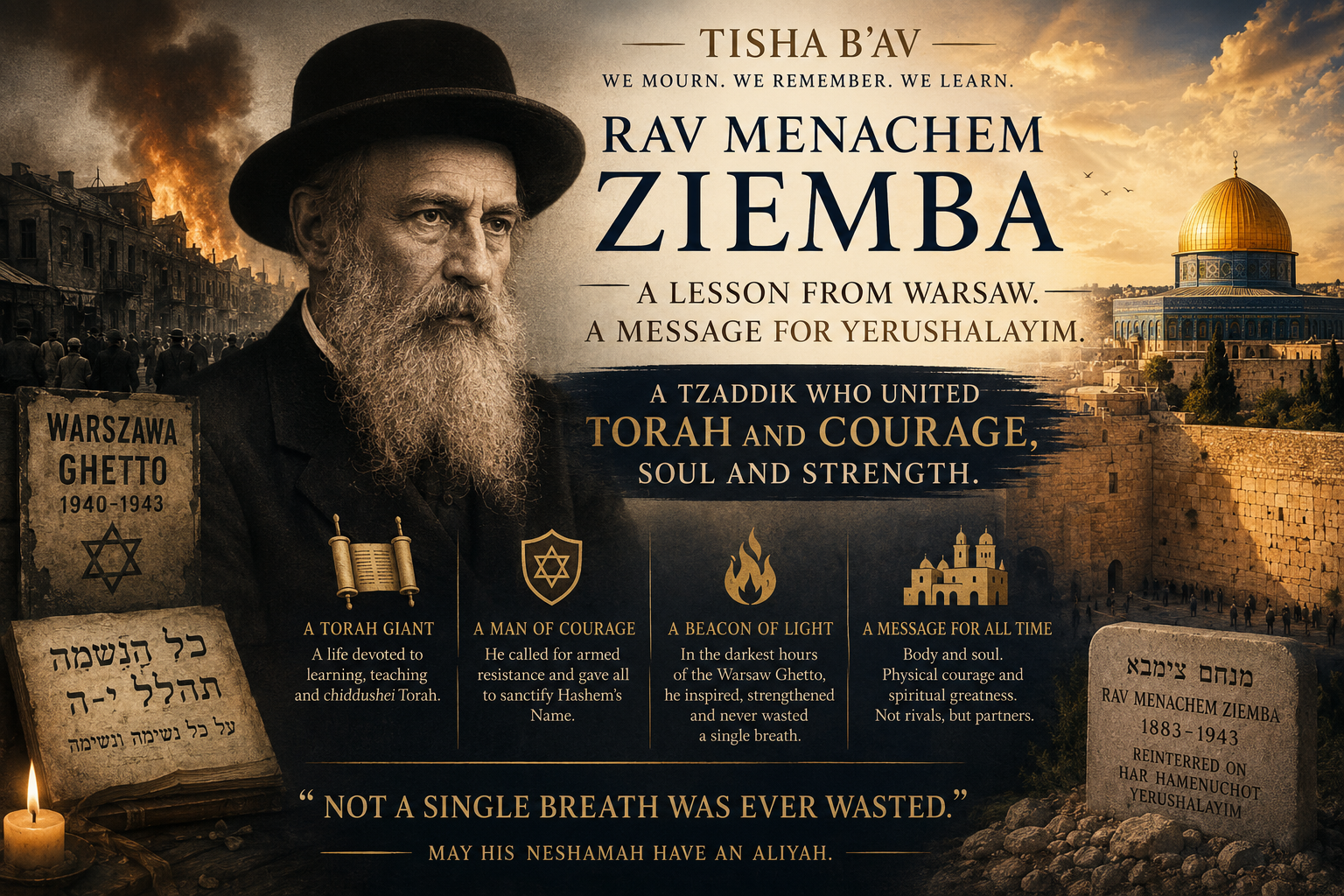
Rav Menachem Ziemba: a Soul of Yerushalayim in the Warsaw Ghetto
-
by
Rabbi Reuven Schrier
- No Comments on Rav Menachem Ziemba: a Soul of Yerushalayim in the Warsaw Ghetto
Rav Menachem Ziemba: a Soul of Yerushalayim in the Warsaw Ghetto
In commemoration of Tisha B’Av, our day of national mourning, I wanted to discuss the life of a spiritual titan who perished in the fires of the Nazi inferno during WWII. As we will see, this great tzaddik from Warsaw – and the powerful message he taught shortly before his passing – speaks directly to the spiritual essence of Yerushalayim.
Rav Menachem Ziemba was born in 1883 to a family of Ger chassidim and was orphaned at a young age. Raised by his grandparents, he forever remembered being brought as a young child before the aging Rav Yehudah Aryeh Leib Alter – the great second Rebbe of the Gerrer dynasty known as the Sfas Emes. With the young Menachem listening intently, the Sfas Emes recited the verse from Tehillim, כל הנשמה תהלל י-ה – every soul shall praise Hashem. The Rebbe then took a deep, audible breadth, as if drawing in the very essence of life itself. The Sfas Emes then recited the teaching of Rebbe Chanina (Bereishis Rabbah 14:9) based on this verse – על כל נשימה ונשימה: with every breath that a Jew takes, he must praise HaKadosh Baruch Hu. That powerful memory would accompany him to the very end, where every breath was used to sanctify Hashem’s name.
A brilliant young prodigy, Rav Ziemba became known as a Talmudic genius and one of the greatest Gedolei Torah in pre-war Europe. While he was initially supported in learning by his generous father-in-law, he eventually took over the family business after his father-in-law passed away. With the economic downturns of the early 20th century and his failing business, he was finally compelled to accept the formal rabbinical posts and leadership positions in Warsaw that he had avoided his entire life. He became an instrumental figure in Agudas Yisrael and was sought out for his wisdom and Torah brilliance.
Then came the Nazi nightmare. Amid the starvation, disease, and terror of the ghetto, Rav Ziemba stood as a beacon of light and hope. He was a paradigm of spiritual resistance against Nazi destruction. Even as conditions steadily deteriorated, not a single breath was wasted. He continued to write chiddushei Torah and encouraged his followers to engage in intensive Torah study. Stories abound of him traveling to clandestine groups learning in dank cellars, testing their Torah knowledge and strengthening their resolve.
Meanwhile, the Nazi deportations to Treblinka accelerated. By the spring of 1943, the Nazis were ready to complete the deportation of the remaining 60,000 Jews in the ghetto. The question of armed resistance had always been discussed in the ghetto, but the Jews had not yet fully understood what awaited them on the other side of the train tracks. Now aware of the horrors of Treblinka and the hopelessness of the situation, the question was again raised to the rabbinical authorities who remained: should the Jews take up arms and resist?
Rav Menachem Ziemba – as is clear from several independent accounts preserving his holy words – was unequivocal: the Jews must resist and fight back. He donated funds to the resistance and declared that it would be a great sanctification of Hashem’s name for the Jew’s to battle the Nazi monsters.
The revolt began on Pesach 1943. Even those who did not take up arms refused to come to the Germans willingly. Stiff resistance slowed the liquidation. The Germans were forced to burn the ghetto to the ground, block by block, to smoke out the remaining Jews. Tragically, Rav Ziemba was gunned down with his grandson in his arms while fleeing his burning bunker, Hashem yikom damo.
After the war, something tragically ironic happened to Rav Ziemba’s legacy. To Jews on two ideological extremes, his position simply didn’t make sense. Secular Zionists could not understand how a Chassidic rabbi could support armed revolt against the Germans. After all, weren’t the rabbis who championed spiritual resistance and Torah learning in the ghettos opposed to physical resistance?
Many religious Jews, meanwhile, reacting against the secular Zionist narrative, insisted that no Torah giant could have supported armed resistance. The traditional path of Yiddishkeit, they argued, was spiritual resistance alone.
But Rav Ziemba’s fiery spiritual stature reveals both extremes to be profound misunderstandings. To him, there was no contradiction between his chiddushei Torah and waging battle against Amalek. These were not competing missions, but complementary expressions of the Jewish people’s power. The physical struggle against the enemies of Klal Yisrael drew its strength from the same fiery neshamah that burned within those dank cellars filled with words of Torah.
As we have discussed many times in the past, Yerushalayim is a city that binds the higher spiritual realms to the lower physical world. It was in Yerushalayim that Adam’s Godly soul first entered his physical body. The Beis HaMikdash itself was the keystone for revealing Godliness within the physical world. Rather than being separated from the comings and goings of earthly life, our holiest Temple was deliberately located in the heart of our capital city – an economic and political center. As Dovid and Shlomo HaMelech taught in the city they built and sanctified, the true purpose of a Jew is not to flee the physical world, but to elevate it with his Godly soul.
With Yerushalayim destroyed, a darkness descended upon the world. Within the confusion of galut, a tragic bifurcation between body and soul emerged. Jews from opposite extremes came to view physical strength as somehow incompatible with spiritual greatness. The message of Yerushalayim, that the physical world can only be sanctified through its chibbur to higher spiritual realms, was forgotten.
But for Rav Ziemba, this crucial message was never lost.
After the war, Rav Ziemba’s makeshift grave was discovered among the ruins of the ghetto. He was eventually reinterred on Har HaMenuchot in Yerushalayim. There is something profoundly fitting about this. Rav Ziemba embodied the very lesson that Yerushalayim was meant to teach the world: that body and soul, physical courage and spiritual greatness are not rivals, but partners.
On Tisha B’Av, we mourn a city that once united heaven and earth. We mourn a world fractured by the loss of that vision. Yet in the flames of the Warsaw Ghetto, Rav Menachem Ziemba demonstrated that the message of Yerushalayim had not been extinguished. Not a single breath was ever wasted.
toto togel
toto togel
situs gacor
situs togel
toto togel
toto togel
toto togel
link gacor
toto togel
link gacor
togel online
slot gacor
link gacor
situs gacor
toto togel
kampungbet
toto togel
link gacor
toto togel
situs togel
situs togel
toto togel
link gacor
slot gacor
slot gacor
situs togel
togel online
kampungbet
situs gacor
toto togel
slot gacor
link gacor
situs hk
situs hk
situs toto
slot gacor
link gacor
situs toto
situs togel
toto
link gacor
slot gacor
link gacor
situs gacor
toto togel
situs toto
toto togel
toto togel
toto togel
toto togel
toto togel
kampungbet
kampungbet
kampungbet
situs gacor
situs gacor
toto togel
kampungbet
kampungbet
situs gacor
kampungbet
kampungbet
kampungbet
kampungbet
kampungbet
kampungbet
kampungbet
kampungbet
kampungbet
kampungbet
kampungbet
kampungbet
kampungbet
kampungbet