No products in the cart.
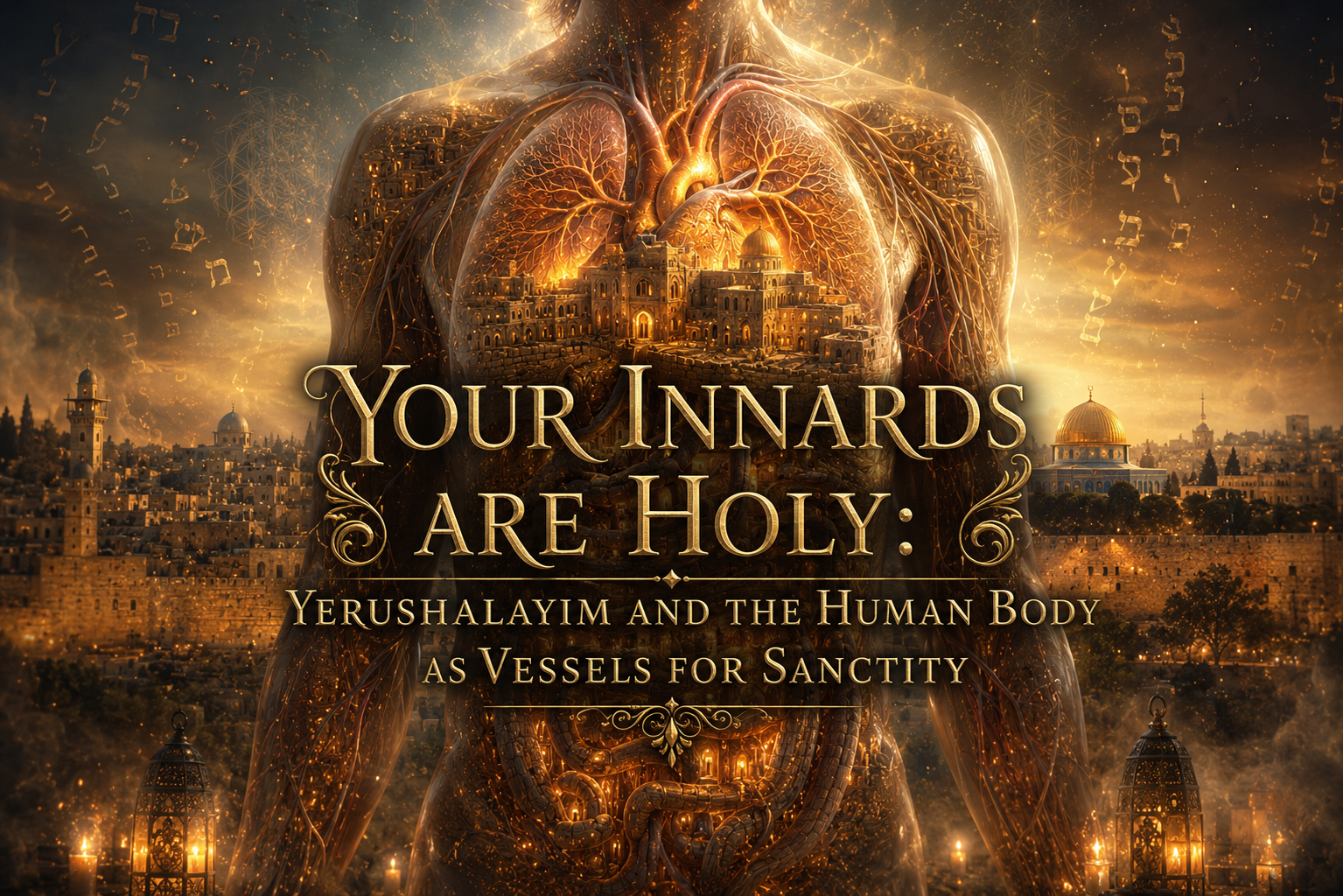
Your Innards Are Holy: Yerushalayim and the Human Body as Vessels for Sanctity
-
by
ateretcohanim
- No Comments on Your Innards Are Holy: Yerushalayim and the Human Body as Vessels for Sanctity
The vow of abstinence declared by the nazir spawned a major hashkafic and halachik debate among Chazal and the Rishonim regarding asceticism and fasting. On the one hand, the Torah describes the nazir as קדוש הוא לה’ – holy to Hashem. Yet upon successfully completing his vow, the nazir must bring a korban chatat, a sacrifice generally reserved for sinners. Why should someone who voluntarily embraces a higher degree of holiness be deemed sinful?
Building upon these conflicting indications, the Tannaim and Amoraim debate whether nezirut is recommended or misguided. Rebbe Elazar HaKfar and Shmuel maintain that the nasir is considered a sinner for engaging in unnecessary abstinence and prohibiting upon himself that which the Torah permitted (Ta’anit 11a). Rebbe Elazar ben Shamua, however, disagrees, viewing the nazir as an inherently holy individual. Each opinion addresses the conflicting sources embedded in this week’s parshah.
The Gemara Ta’anit expands this debate beyond the nazir alone. These same sages dispute the value of fasting generally. If voluntarily abstaining from wine is sinful, then certainly refraining from food entirely would be even more problematic. (Parenthetically, even Shmuel agrees that there are circumstances in which fasting or nezirut may be appropriate; This is much like medicine, which is harmful when taken unnecessarily but essential when addressing illness. See Tosafot to Ta’anit 11a and Rambam in Shemona Perakim.)
Conversely, if Rebbe Elazar views nezirut as commendable, then fasting would certainly be deemed a holy endeavor. However, the Gemara qualifies that even Rebbe Elazar only praises fasting when it does not weaken the body. Once a person’s health deteriorates through fasting, he too agrees that the faster is deemed a sinner.
Rebbe Elazar’s prooftext is strikingly unusual. He invokes the verse in Hoshea (11:9), in which Hashem declares that he will not enter the heavenly Yerushalayim until the earthly Yerushalayim is built below (see Ta’anit 5a, we discussed this pasuk two weeks ago). Rebbe Elazar homiletically interprets בקרבך קדוש as “your innards are holy”: one should view his body and digestive system as sanctified, nourishing them properly so they remain healthy and vibrant. If fasting damages one’s health, it is akin to destroying consecrated property.
At first glance, this derasha seems quite far-fetched. In a verse discussing Yerushalayim, where does Rebbe Elazar see a reference to the human body?
While initially perplexing, Rebbe Elazar is drawing upon a foundational principle: Yerushalayim serves as the ultimate model for how spirituality properly interfaces with physicality. Rav Chayim Volozhiner teaches that the Beit HaMikdash and Yerushalayim provide a framework for understanding the Jewish soul (Nefesh HaChayim 1:4). The entire enterprise of kodashim – sanctified objects and korbanot brought to Yerushalayim and the Mikdash – rests upon the premise that physicality is not meant to be rejected but rather sanctified.
Physical Yerushalayim functions as a bridge between heaven and earth. Hashem declares that His Presence cannot dwell within the heavenly Yerushalayim until the earthly city is physically built below. Just as Yerushalayim must be beautiful, vibrant, and properly constructed in order to serve as a vessel for the Shechinah, the human body must likewise be healthy and well maintained in order to house the soul.
Even Rebbe Elazar, who praises ascetic practice, agrees holiness cannot come at the expense of destroying the vessel that houses it. A weakened vessel is not spiritually superior. Just the opposite; a strong body filled with vitality becomes sanctified to Hashem when used as a vehicle to bind heaven and earth together.
Just as the Shechinah descends only into a rebuilt Yerushalayim below, the neshama can only fully illuminate a body that is healthy, stable, and whole. The task is not to break the vessel, but to sanctify it.