Dayeinu: When “Enough” Isn’t Enough
 Rabbi Reuven Schrier
Of all the favorite songs recited over seder night, Dayeinu is perhaps the most beloved. With each stanza, we recount another Divine kindness of Yetziat Mitzrayim and beyond, declaring each time דיינו – this alone would have been enough.
Beautiful. But as many commentators note, the song is quite puzzling. A mentor of mine compared this song to a passenger on a plane who, moments after takeoff, enters the cockpit to thank the pilot and insists that he has already done enough. But a takeoff without a landing is not a chessed; it’s a catastrophe.
Had Hashem split the sea without drowning the Egyptians, we would have been dragged back or killed. Had he brought us into the desert without providing us with the heavenly manna, we would have starved. Without water, food, and protection, the Jews themselves repeatedly complain that Mitzryaim would be preferable to freedom.
So what does the song actually mean? How can we thank Hashem for “takeoff” and claim we don’t need a landing?
The commentators offer two beautiful approaches. Some suggest that the intention of Dayeinu is not about the sufficiency of each miracle, but about our worthiness to receive it. With each miracle that Hashem performed, we acknowledge that we did not deserve it. Each step of the redemption process was an entirely undeserved chessed. Whether it would have been enough is beside the point. As the plane soars through the air, we are recognizing that there isn’t really any fuel left in the tank. And yet, our Divine pilot mercifully continues to steer us to safety. Truly, Hashem, each miracle alone would be enough to exhaust all of our zechuyot. Yet you still pour Your compassion upon us. Dayeinu!
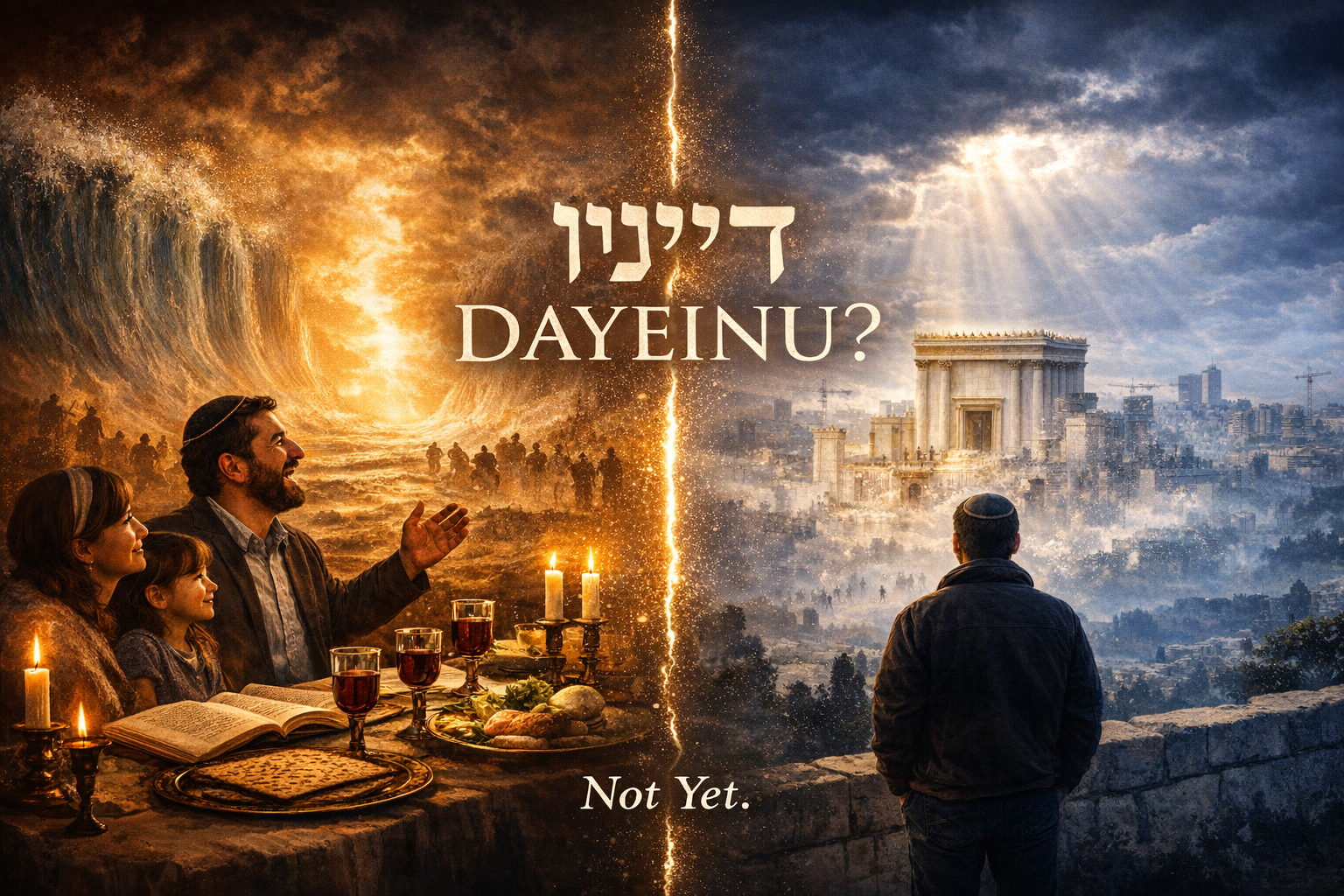
A second homiletic approach to this piyyut reads Dayeinu not as a statement, but as a quesiton: Dayeinu?! Would that truly have been enough?!
Yes, we do not deserve anything from the Ribbono Shel Olam. But like pampered children who know the enduring love of their royal father, Klal Yisrael recounts the miracles of the redemption and boldly insist that they are not enough. Redemption that stops midway is incomplete.
And this is where Yerushalayim enters the picture.
It is true that our freedom from physical bondage was essential. And our physical sustenance in the midbar was indispensable. Most of all, our acceptance of the Torah at Har Sinai provided us with existential meaning and spiritual freedom. But ultimately, the redemption process doesn’t end with these essential events. It is supposed to culminate in the building of the Beit HaMikdash. It is not until Hashem’s Shechinah rests among us, with the great Talmidei Chachamim of the Sanhedrin learning Torah on the Har HaBayit, that this whole chain of events reaches its ultimate purpose.
Yes, we may not deserve even a single piece of this epic journey. But we are spoiled children who have experienced undeserved Divine assistance for thousands of years. After generations of boundless Divine kindness, including the miracles we have witnessed in our own days, we emphatically declare that it is not enough.
The song of Klal Yisrael’s destiny does not end until Yerushalayim is fully restored.